
Heavy Machinery Shipping from China to UAE: 2026 Route Guide
Overview
Heavy machinery shipping from China to the UAE has changed significantly in 2026. With the Strait of Hormuz remaining severely disrupted, conventional China–UAE Gulf routing cannot be treated as a normal ocean freight movement. Machinery importers now need to consider alternative gateways, vessel availability, landbridge options and the specific requirements of oversized and project cargo.
The current situation has already pushed shipping lines and logistics providers toward Khor Fakkan, Fujairah and alternative multimodal routes. COSCO, for example, suspended bookings to several UAE destinations while specifically excluding Khor Fakkan and Fujairah from the suspension. Current UAE port reporting also confirms that Fujairah, Khor Fakkan and Dibba continue operating, while the situation remains fluid.
For companies importing excavators, cranes, loaders, generators, construction equipment, industrial machinery and oversized project cargo from China, the critical question in 2026 is no longer simply the ocean freight rate. It is which China–UAE route can move the machinery reliably to the required UAE destination.
China to UAE Heavy Machinery Shipping Routes in 2026
The appropriate route depends on the machinery's dimensions, weight, shipping method and final destination. Containerized machinery can potentially move through alternative UAE east-coast gateways, while oversized machinery requiring RoRo or breakbulk needs separate vessel and port planning.
Khor Fakkan and Fujairah are particularly important because they are located on the UAE's east coast outside the Strait of Hormuz. Both ports have become central to maintaining cargo flows into the UAE during the current disruption. Reuters reported significant increases in cargo volumes through both ports as Gulf shipping was disrupted.
For suitable containerized machinery, the practical route can therefore be structured as China to Khor Fakkan or Fujairah to UAE inland transport to final site.
For heavy project cargo, however, vessel availability and port handling must be confirmed specifically for the cargo. Breakbulk, general cargo and RoRo operations have faced substantially different operational conditions from container services during the disruption.
Heavy Machinery Shipping from China to Khor Fakkan
Khor Fakkan Port has become one of the most strategically important gateways for China–UAE cargo during the Hormuz disruption.
Its east-coast location provides maritime access without requiring the vessel to pass through the Strait of Hormuz. The port has consequently seen a major increase in container traffic, with Khor Fakkan being developed as an important alternative gateway for UAE import and export cargo.
For machinery that can move by container, a China to Khor Fakkan shipping solution followed by UAE inland transportation can be commercially attractive, particularly for cargo destined for Dubai, Sharjah and the Northern Emirates.
However, oversized and non-containerizable machinery must be evaluated separately. The availability of suitable breakbulk, RoRo or heavy-lift vessel capacity cannot be assumed from container service availability.
Heavy Machinery Shipping from China to Fujairah
Fujairah Port provides another important China–UAE gateway outside the Strait of Hormuz.
Fujairah's east-coast position allows cargo to enter the UAE without relying on a vessel transit through the Strait. The port has remained operational during the disruption and has experienced increased cargo activity as vessels and cargo flows have been rerouted.
For heavy machinery destined for Dubai, Abu Dhabi, Sharjah, Ras Al Khaimah or other UAE locations, Fujairah can be considered as part of an ocean freight plus UAE heavy-haulage solution.
The final decision should consider cargo handling capability, vessel availability, port congestion, inland distance and the availability of the required specialized trailer.
What About Jebel Ali for Heavy Machinery?
Jebel Ali remains a major UAE logistics hub, but its geographical position inside the Gulf means that its maritime accessibility must be considered differently from Khor Fakkan and Fujairah during the current Strait of Hormuz disruption.
This does not make Jebel Ali irrelevant. Instead, it means the routing must be assessed based on the actual carrier service and available contingency solution.
For some cargo, Jebel Ali may continue to be used through landbridge arrangements from alternative east-coast gateways. Maersk, for example, has published contingency landbridge solutions involving Khor Fakkan, Fujairah and Jebel Ali.
For machinery importers, this can mean separating the maritime and inland portions of the movement: the cargo enters through an accessible UAE gateway and is then transported by road to the required destination.
China to UAE Heavy Machinery by Landbridge
The China–UAE landbridge model has become increasingly important during the Hormuz disruption.
Instead of relying entirely on a conventional vessel call at a Gulf port, cargo can be discharged through an alternative gateway and transported inland to the consignee or another UAE logistics hub.
This is particularly relevant for machinery that can be containerized or transported using specialized road equipment.
The landbridge can connect Khor Fakkan or Fujairah with Dubai, Abu Dhabi and other UAE destinations, allowing importers to maintain cargo flows despite disruption to conventional maritime access. Major carriers have already introduced specific landbridge solutions for UAE cargo.
Breakbulk Shipping from China to UAE
Breakbulk shipping from China to UAE requires a different approach from standard container freight.
Large excavators, cranes, generators, transformers, production equipment and industrial machinery may require multipurpose, heavy-lift, general-cargo or RoRo vessels.
The current market makes this particularly important because container availability does not automatically mean breakbulk availability. Port advisories have reported significantly longer waiting periods for breakbulk, general cargo and RoRo vessels at certain UAE east-coast facilities during periods of rerouting and congestion.
For oversized machinery, the vessel should therefore be secured before the factory pickup is finalized.
RoRo Shipping for Construction Machinery
RoRo can be suitable for self-propelled machinery such as excavators, loaders, rollers, mobile cranes and other construction equipment.
The advantage is that machinery can be driven or rolled onto the vessel rather than requiring conventional container loading.
However, RoRo service availability is currently dependent on the specific China origin, UAE gateway and vessel schedule. During the present market conditions, the availability of a suitable RoRo sailing should be confirmed before quoting a firm delivery date.
Flat Rack and Out-of-Gauge Machinery Shipping
Machinery that exceeds standard container dimensions but can be safely secured to specialized equipment may move by flat rack or other out-of-gauge container solutions.
This can be an efficient alternative to breakbulk when the machine's dimensions and weight remain within the carrier's accepted parameters.
For 2026 China–UAE shipments, flat rack availability, carrier acceptance and destination handling should be confirmed before the cargo is delivered to the Chinese port.
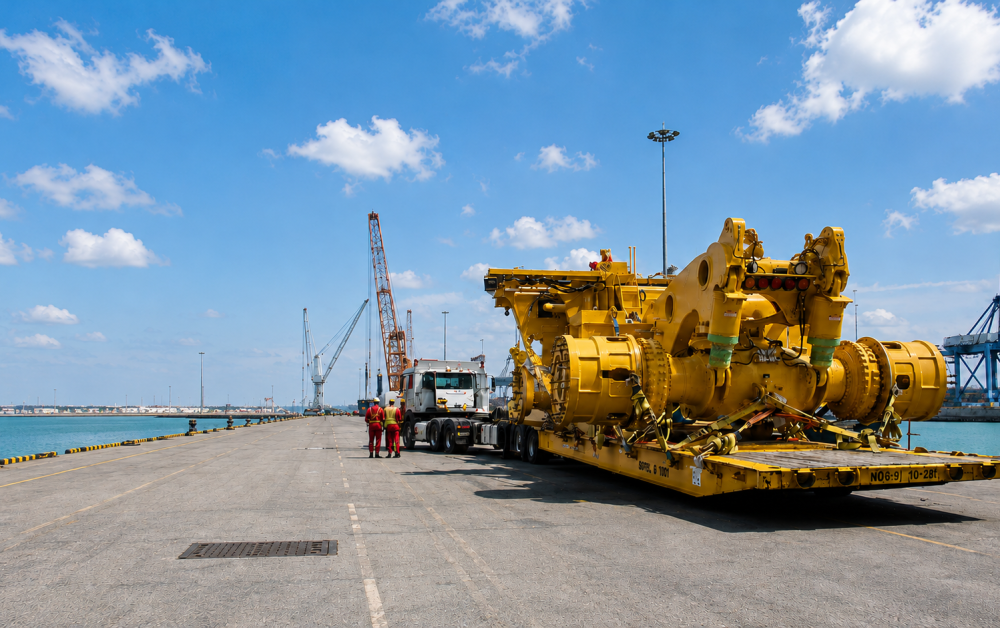
Oversized Cargo Transport
LBX Logistics delivers end-to-end project cargo solutions for oversized, heavy-lift, and complex shipments across the UAE, GCC, and global markets. From engineering coordination to multimodal transport and site delivery, we handle every detail with precision and control.
Heavy Machinery Shipping Cost from China to UAE
There is no reliable single market rate for heavy machinery shipping from China to UAE during the current disruption.
The final cost depends on the machinery dimensions and weight, Chinese pickup location, shipping method, available gateway, ocean freight, port handling, landbridge requirements, customs clearance, specialized trucking, permits and final-site delivery.
The current routing environment can also create additional costs through transshipment, alternative port handling, inland repositioning, storage and equipment shortages.
For this reason, the lowest ocean freight rate is not necessarily the lowest total logistics cost.
A proper quotation should be based on the complete movement from the Chinese factory to the UAE project site.
Heavy Machinery Transit Time from China to UAE
Transit time in 2026 should not be based on historical China–UAE schedules.
The Strait of Hormuz disruption has changed vessel routing, port selection, cargo discharge arrangements and inland transportation requirements. Current shipping conditions remain fluid, and UAE ports continue to handle increased volumes through alternative gateways.
For heavy machinery, the total transit should include factory pickup, export customs, origin port handling, vessel loading, ocean transit, discharge, UAE customs clearance, heavy haulage and final delivery.
For breakbulk and RoRo machinery, vessel availability and port waiting time can have a greater impact on the schedule than the ocean transit itself.
Heavy Machinery Customs Clearance in UAE
Machinery imports require accurate commercial and customs documentation. The commercial invoice, packing list, bill of lading and equipment information must correspond with the physical cargo.
For heavy equipment, the machinery description should identify the equipment type and, where applicable, model, serial number, quantity and weight. Correct HS classification should also be established before shipment.
Where machinery arrives through Khor Fakkan or Fujairah and then moves inland to another UAE location, the customs and transport structure should be planned before discharge.
Heavy Haulage from Khor Fakkan or Fujairah
Discharging heavy machinery is only the beginning of the UAE operation.
Large machinery may require low-bed trailers, extendable trailers, modular equipment or other specialized heavy-haulage solutions. The route from Khor Fakkan or Fujairah to the final site must be assessed against the machine's height, width, length and gross weight.
For oversized equipment, route restrictions, permits, bridge clearances, overhead obstacles and site access can affect the delivery plan.
Where the machinery requires a crane for unloading, the lifting capacity and lifting arrangement should be confirmed before the cargo arrives.
Door-to-Door Heavy Machinery Shipping China to UAE
For machinery importers, the most reliable approach is to manage the shipment as one factory-to-site project logistics movement.
The logistics plan can connect the Chinese factory with the appropriate export port, alternative UAE gateway, customs clearance process, specialized trucking and final project site.
Depending on the cargo, the solution can involve FCL, flat rack, RoRo, breakbulk, Khor Fakkan, Fujairah or a landbridge arrangement to another UAE destination.
This approach is particularly important during the current market because the maritime route and inland delivery route need to be considered together.
Conclusion
LBX Logistics coordinates heavy machinery shipping from China to UAE based on the current 2026 operating environment.
We evaluate the machinery specifications, Chinese origin, UAE destination and available routing before determining whether the shipment should move by container, out-of-gauge equipment, RoRo, breakbulk or an alternative multimodal solution.
For suitable cargo, the logistics operation can include China factory pickup, export customs, ocean freight, Khor Fakkan or Fujairah discharge, UAE customs clearance, landbridge transportation, heavy haulage, permits, crane coordination and final-site delivery.
The objective is to provide a workable China-to-UAE machinery logistics solution, rather than simply quoting an ocean freight rate that may not reflect current routing conditions.
Frequently Asked Questions
Heavy machinery can move by FCL, flat rack, RoRo, breakbulk or multimodal landbridge depending on its dimensions, weight and configuration. Because of the current Strait of Hormuz disruption, Khor Fakkan and Fujairah should be evaluated alongside conventional UAE gateways.
Yes. Khor Fakkan has become an important alternative UAE gateway during the Hormuz disruption, particularly for containerized cargo.
Yes. Fujairah remains operational and provides an east-coast gateway outside the Strait of Hormuz.
Yes. Machinery can potentially enter through Khor Fakkan or Fujairah and continue to Dubai by specialized road transport or landbridge, depending on the cargo and customs structure.
Yes. Excavators can move by RoRo, breakbulk, flat rack or suitable container equipment depending on their dimensions, weight and operating condition.
Yes. Cranes can be handled as RoRo, breakbulk, flat rack or project cargo depending on their configuration and dimensions.
There is no universal cheapest method. The correct comparison should include ocean freight, alternative gateway charges, port handling, customs clearance, inland transportation, specialized equipment and final delivery.
Provide the machinery description, length, width, height, gross weight, quantity, Chinese pickup location and UAE delivery location. Photos and lifting information are recommended for oversized machinery.